loading
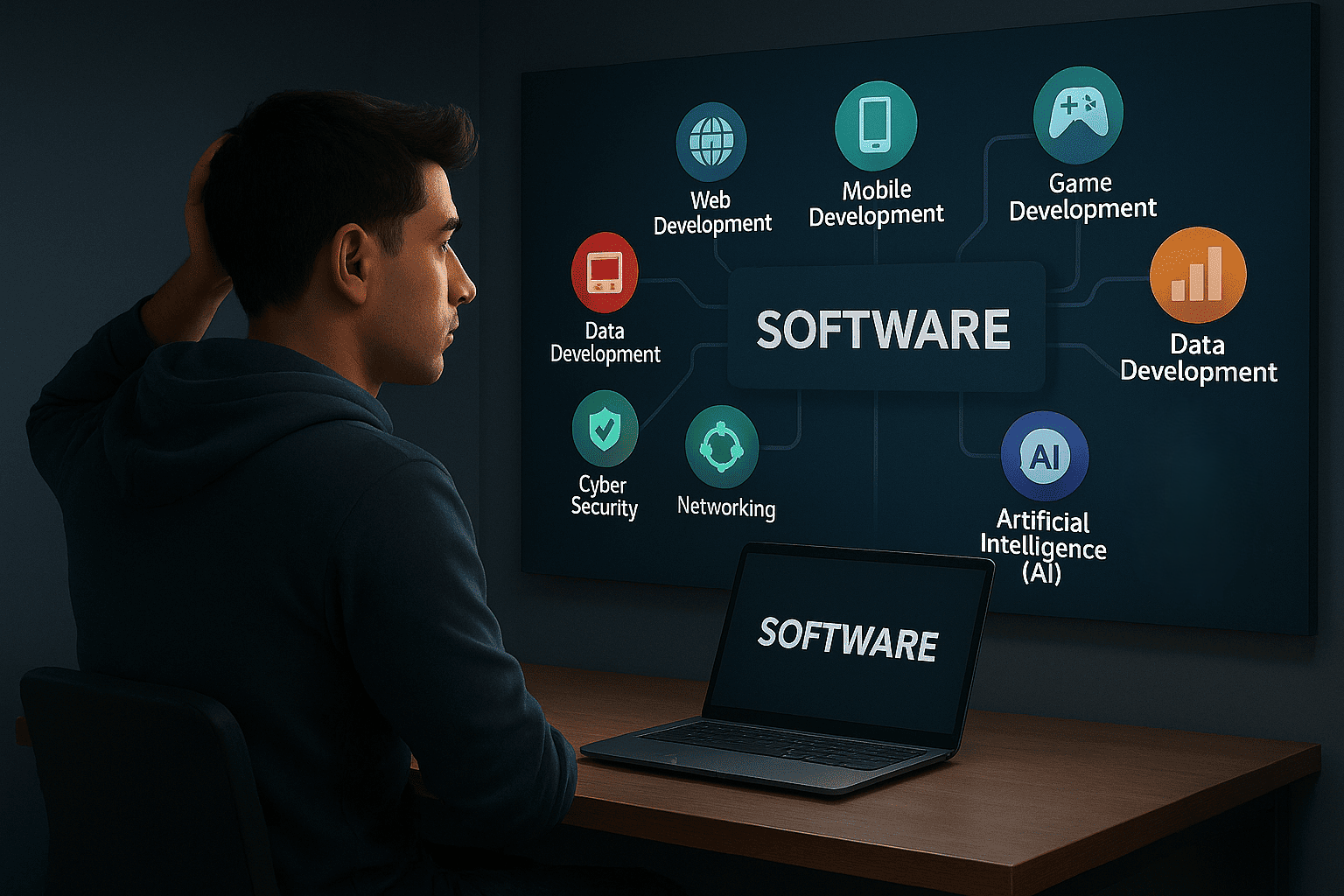
Software Development Fields: A Guide to Understanding Software and Choosing Your Path
- Backend
- Frontend
- DevOps
- Hardware
- Desktop Application Development
- Web Development
- Game Development
- Cybersecurity
- Artificial Intelligence (AI)
- Network Engineering
- Mobile Application Development
When you first enter the world of programming you'll find yourself facing many overlapping terms. Front-end, back-end, artificial intelligence, cybersecurity, mobile apps.
Each one feels like a separate world.
The problem isn't the abundance of choices. The problem is that you're trying to choose before you understand what each field actually does.
The difference between programming fields isn't in the language you use. It's in the type of problem each field works to solve.
What Is Software?
Everything in technology divides into hardware and software.
Hardware is the physical part. The phone, the computer, the router.
Software is our means of communicating with hardware and what makes that physical part perform a function we understand. The operating system is software. Apps are software. The systems running companies, banks, and hospitals are all software.
Every programming field is a different way of building this type of system.
Web Development: Front-End, Back-End, and Full Stack
It's building websites and applications that run through the browser.
A website has become the primary way to access any digital service. That's why most systems start from the web or rely on it.
The field divides into Front-End — the part the user sees and interacts with — and Back-End — the part that processes data, stores it, and responds to requests. Booking.com's website and its mobile app both talk to the same Back-End.
Full Stack is someone who works on both sides.
What distinguishes this field is that all parts of the system can be built programmatically without special hardware. One person can build a complete project, or a full team can build massive systems. It opens up freelance work alongside employment in any market.
If you choose this field you'll work with HTML, CSS, and JavaScript on the front-end, and languages like Python, PHP, or Node.js on the server. These are examples, not fixed boundaries.
Mobile App Development: Android, iOS, and Cross Platform
It's building applications that run on phones of all kinds. There's Android and iOS, or building one app that works on both through Cross Platform.
The phone is the primary point of use for most people today. Many products depend on it directly, which keeps demand high in most job markets.
One developer can build a complete app in small and medium projects, and getting started doesn't require a high-spec computer — unlike AI or DevOps which need more resources to begin.
If you choose this field you'll use Kotlin, Java, or Swift, or tools like Flutter and React Native for Cross Platform. These are examples, not an exhaustive list.
Desktop Software Development
It's building programs that run directly on a computer without a browser.
Many systems moved to the web because they work from anywhere with internet, don't stop if one employee's device breaks, and don't lose data. But some fields still need local performance or direct device connections.
Like video and audio editing software, engineering and CAD software, medical systems connecting directly to external devices, and security tools not permitted to run over the internet.
Opportunities exist but are narrower than web and mobile, usually inside specialized companies or sectors.
Game Development
It's building the interaction logic of the game itself. Movement, physics, events, character behavior. Design, art, and sound are separate fields handled by other specialists.
Small games can be built individually, but large games need full teams and funding. Solo opportunities are limited compared to web and mobile.
Most game development relies on ready-made engines you build your game logic on top of, rather than building everything from scratch.
Data Science and Artificial Intelligence
It's working with data and extracting results from it. Recommendation systems in YouTube and Netflix, facial recognition, user behavior analysis — these are all applications of this field.
It depends on both programming and mathematics. Entering it takes longer than other fields because it requires a clear mathematical foundation before any programming tool.
Salaries in this field are among the highest in the market currently.
Cybersecurity and Information Security
It's protecting systems from breaches and discovering vulnerabilities before attackers reach them, and investigating security incidents after they occur.
The more dependence grows on digital systems, the greater the need for protection. A single day's delay in discovering a vulnerability can cost a company massive losses.
The field usually operates inside companies or institutions that have real systems needing continuous monitoring.
Network Engineering
It's connecting systems to each other and managing communication between them. From small networks inside a company to massive systems linking data centers.
The field is tied to pre-existing physical infrastructure, so work is usually inside institutions and freelance opportunities are very limited.
DevOps and Cloud Computing
It's running systems after they're built and setting up the development environment that fits different project requirements. Deployment, management, monitoring, and ensuring service stability.
As system scale increased this role became its own specialization. Work is almost always inside technical teams, solo opportunities are fewer than web and mobile, but salaries tend to be above average.
You'll work with deployment tools, servers, and cloud services. The landscape here changes quickly.
How to Choose Your Specialization
There's no field better than another. The choice connects to what you want to reach, the type of work you prefer, and the environment you'll work in.
If you lean toward seeing a clear result from what you build, web or mobile are suitable starting points. If you lean toward understanding data and patterns, data science and AI is closer to you. If you care about understanding systems from the inside, cybersecurity, DevOps, or networking is nearest.
This is just a starting guide, not a final decision.
Your local job market may differ. You may not have a clear inclination at all. In that case, start with the field closest to your current entry opportunity. Don't wait for clarity before trying. Clarity comes during the work, not before it.
Common Mistakes When Choosing a Programming Specialization
Choosing a field because it's trending. Trends change, skills stay.
Switching specializations quickly. The beginning in any field is unclear, and the first month is hard in every field without exception.
Learning without applying. Watching courses without practice doesn't teach you programming — it teaches you that you watched programming.
Your comment matters
Share with me your feedback or any note you’d like to add

Why Do Most Programmers Stop Growing After the First Year?
- mohammed albadry 000
- 0
Your Technical Quality Might Be the Reason You Fail
- mohammed albadry 000
- 0
How Does a Professional Programmer Think? Decisions Before Code
- mohammed albadry 000
- 0
AI and Its Tools for Programmers: What Has Actually Changed?
- mohammed albadry 000
- 1
How to Grow in Your Programming Career? The Difference Between Junior, Mid, and Senior
- mohammed albadry 000
- 1