loading
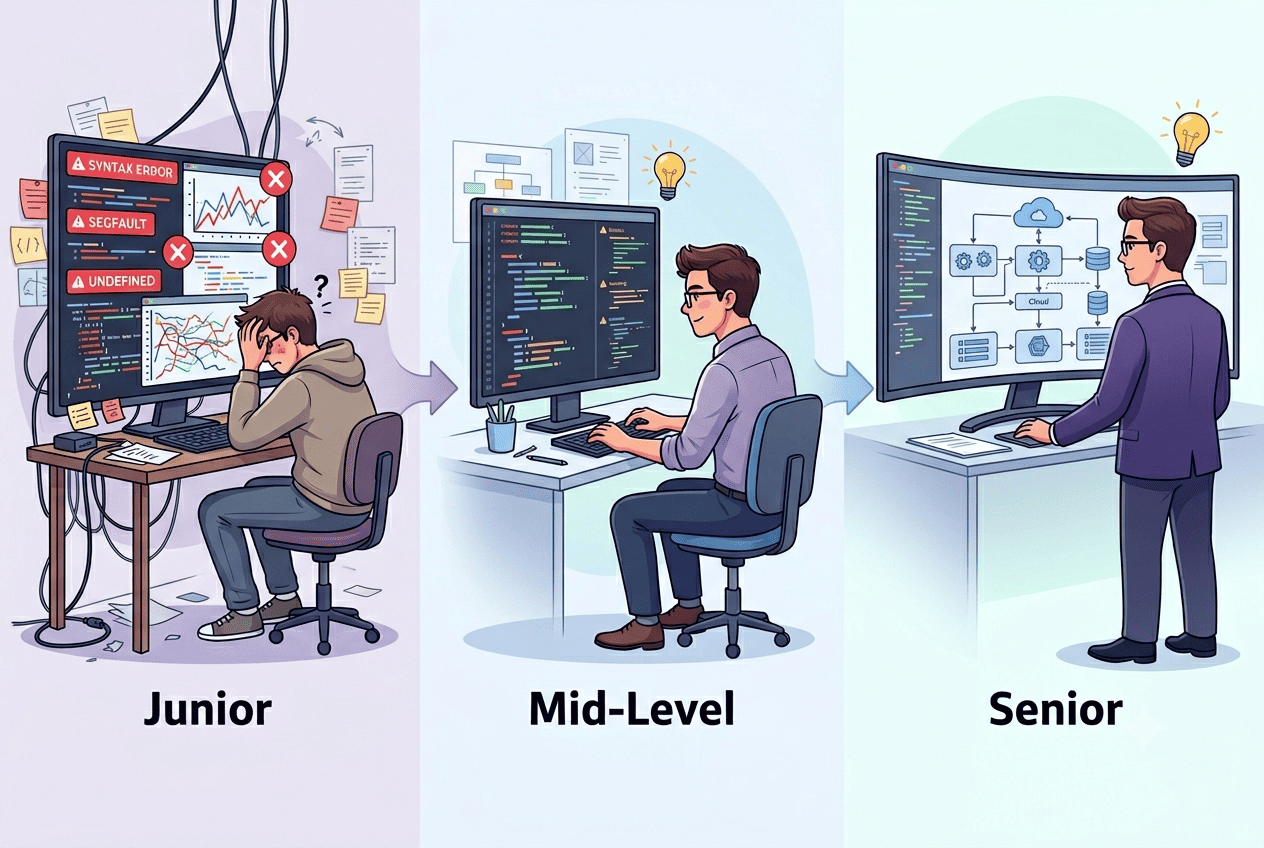
How to Grow in Your Programming Career? The Difference Between Junior, Mid, and Senior
Many programmers spend years working without actually advancing. They accumulate time-based experience but stay at the same level in terms of thinking, responsibility, and market value.
Experience alone won't advance you. The type of experience and how you handle it is what advances you.
Professional Levels Are Not Years of Experience
The most common mistake is tying professional level to number of years.
Someone can work five years and still think and act like a Junior. While another person surpasses that level in just two years.
Years measure time. Level measures how you think and how much responsibility you can handle.
Junior Developer
The beginning of real contact with the job market. They have a technical foundation that allows execution but still need guidance in most decisions.
Works on specific, clear tasks. Needs direction when facing new problems. Focuses more on completing the task than understanding why it's done this way. Sees the code in front of them more than the full system.
To grow from this level: start asking "why" alongside "how." Read teammates' code and learn from their approaches. Learn to read error messages and diagnose problems independently.
Mid-Level Developer
The stage where a programmer can work with real independence on complete tasks without constant guidance.
Completes tasks independently and knows when to ask for help. Can reasonably estimate the time needed for a task. Begins thinking about how their decisions affect the rest of the system.
The common trap at this level is comfort. The person who reaches mid-level and stops challenging themselves stays here for years. Growth requires constantly working on things that make you slightly uncomfortable.
Senior Developer
A Senior isn't just a more experienced programmer. They're someone whose experience has fundamentally changed how they think.
Thinks about the problem before the code. Sees the tradeoffs and hidden costs in every technical decision. Can break down an entire project into tasks distributed across a team. Influences the quality of work of those around them, not just their own. Knows when a simple solution is better than an elegant one.
A Senior isn't necessarily the one who knows the most technologies. They're the one who knows how to solve real problems in their real context, with the pressures of time, resources, and changing requirements.
Beyond Senior
After the Senior level, paths branch. Technical path — Staff or Principal Engineer: going deeper into the technical side, designing large systems. For someone who loves technology itself and wants to go deep, not wide. Leadership path — Tech Lead or Engineering Manager: focusing on the team and making it more effective. For someone who finds satisfaction in others' success, not just in their own code.
The Traps That Keep You Stuck
Working on the same type of problems. If you've been solving the same type of problems for two years, you haven't gained two years of experience. You've gained the same year twice.
Avoiding what you're not good at. Real growth comes from deliberately confronting what you find difficult.
Isolation from others. A programmer who doesn't read others' code and doesn't receive feedback develops habits they can't see because they never see themselves from the outside.
Ignoring the non-technical side. Communication, managing expectations, understanding business requirements. These skills differentiate Senior from Mid just as much as technical skills do.
Ask yourself now: am I solving harder problems than I was solving a year ago? If the answer is no, you're not advancing — you're repeating.
Your comment matters
Share with me your feedback or any note you’d like to add

How Does a Professional Programmer Think? Decisions Before Code
- mohammed albadry 000
- 0
Why Do Most Programmers Stop Growing After the First Year?
- mohammed albadry 000
- 0
How to Learn Programming the Right Way? A Methodology That Actually Moves You Forward
- mohammed albadry 000
- 0
Your Technical Quality Might Be the Reason You Fail
- mohammed albadry 000
- 0
How to Start Learning Programming? The Foundation That Builds Everything
- mohammed albadry 000
- 0