loading
Your Technical Quality Might Be the Reason You Fail
A programmer spends years refining their skills — learning, building, improving, reading about best practices and applying them. Then they collide with a truth no one told them:
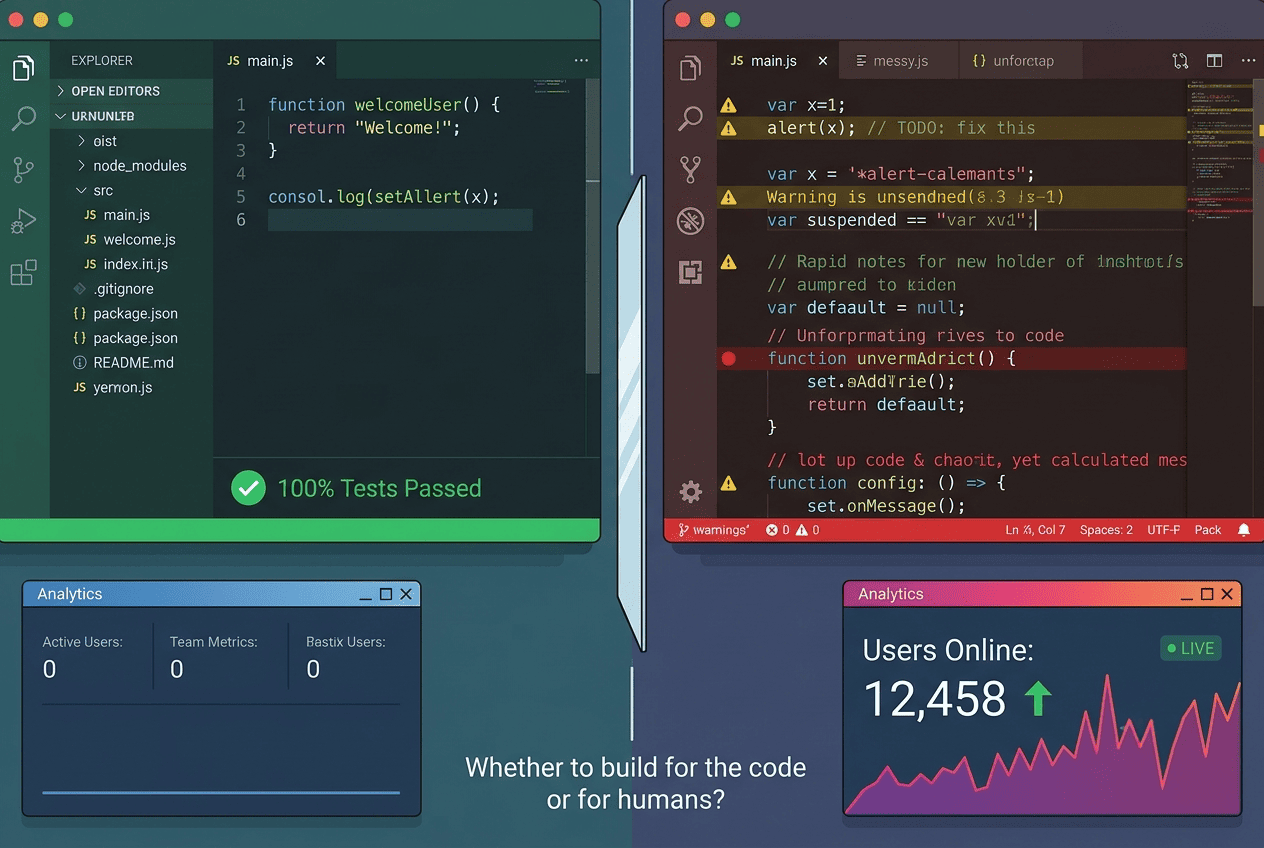
Technical quality is not the only measure of success. And sometimes it's the direct cause of failure.
Not because quality is bad. But because believing it's sufficient on its own is a dangerous illusion that many talented programmers pay for.
Bad Code at a Well-Marketing Company Outperforms Excellent Code Nobody Hears About
This truth irritates many programmers, but it cannot be ignored.
In the actual market, a product that reaches the right people with the right message outperforms the technically superior product that nobody knows exists.
Marketing isn't a luxury that comes after building. It's part of the equation with the same importance as the code you write.
Companies that succeed don't succeed only because their product is technically better. They succeed because they understand who they serve, how to reach them, and how to make them choose them over others.
Your Technical Intelligence Isn't Every Kind of Intelligence
A good programmer develops strong skills in research, self-learning, and solving technical problems. But some fall into a dangerous trap: believing this skill applies to everything.
What they get from researching a field outside their expertise is introductory knowledge at best. The difference between introductory knowledge and real expertise costs projects, money, and time.
Marketing is a science. Team management is a science. Understanding the market is a science. Each requires years of real practice, not hours of research.
Clients and Companies Don't Always Want the Best Technically
A client who wants to launch a pilot version quickly to test their idea and attract funding doesn't want a perfect architecture. They want something that works fast and proves the idea is viable.
A programmer who insists on building the "right way" in this context isn't delivering a better service — they're delivering the wrong service. They're spending the client's time and money building a castle for a project still in the testing phase.
The required technical quality is determined by context. A pilot version has one standard. A stable product serving millions of users has an entirely different standard.
An Excellent Product in the Wrong Market Is Doomed
You could build the best point-of-sale system in the world. But if it's complex enough to require training a supermarket employee, or priced beyond what small shop owners in your market can afford, all that technical excellence is worthless in this specific context.
Success doesn't mean building the best. It means building what suits who you're building for, at the price they can pay, with the simplicity that matches the level of those who will use it.
Extraordinary technology that doesn't match its market isn't an advanced solution. It's the wrong solution for a context that wasn't understood well enough.
You Won't Succeed Alone
Many talented programmers enter the experience of building their own products with high confidence. They know how to build anything technically. And they think that's enough.
But a successful company isn't built by one skill, no matter how great. It needs someone who understands the market, someone who talks to customers and understands their real problems, someone who manages cash flow.
And your time as a programmer is limited. Every hour you spend learning marketing or accounting is an hour you didn't spend building your product or developing your core skill.
Those who know their limits and find people to complete what they lack build faster and further than those who insist on mastering everything alone.
Your technical quality is a real skill and an indispensable foundation. But it's just one piece of a much larger equation. A successful product needs working code, a market that understands it, marketing that reaches it, a price that fits it, and a team that completes it. Those who understand this full equation and know their role in it clearly put themselves in the right place.
Your comment matters
Share with me your feedback or any note you’d like to add

Why Do Most Programmers Stop Growing After the First Year?
- mohammed albadry 000
- 0
Software Development Fields: A Guide to Understanding Software and Choosing Your Path
- mohammed albadry 000
- 0
How Does a Professional Programmer Think? Decisions Before Code
- mohammed albadry 000
- 0
How to Grow in Your Programming Career? The Difference Between Junior, Mid, and Senior
- mohammed albadry 000
- 1
How to Learn Programming the Right Way? A Methodology That Actually Moves You Forward
- mohammed albadry 000
- 0